standard glossary text
") (GRTS) ## The textile processing [standard](https://gots.vorschau.website/resources/glossary/standard "standard glossary text
") for responsible fibres The Global Responsible Textile Standard (GRTS) is a globally recognised certification for textiles made with certified responsible fibres. Developed by Global Standards, the non-profit organisation behind [GOTS](https://gots.vorschau.website/resources/glossary/gots "The worldwide leading voluntary sustainability standard for the post-harvest textile value chain for certified organic fibres, covering environmental criteria, human rights, social criteria and business conduct.
") (Global [Organic](https://gots.vorschau.website/resources/glossary/organic "'Organic' is a regulated term used to distinguish systems of managed production and products derived therefrom that adhere to principles of health, ecology, fairness and care, and which are certified compliant to an organic standard's regulations by an Approved Certification Body.
GOTS defines organic textiles as being made with fibres from organic agriculture systems that are certified to one of the IFOAM Family of Standards, and that are processed in socially and ecologically responsible ways, in alignment with organic principles.
Human rights are rights inherent to all human beings, regardless of race, sex, nationality, ethnicity, language, religion, or any other status. Human rights include the right to life and liberty, freedom from slavery and torture, freedom of opinion and expression, the right to work and education, and many more. Everyone is entitled to these rights, without discrimination. (Source: Office of the High Commissioner for Human Rights, United Nations)
") including social criteria , [traceability](https://gots.vorschau.website/resources/glossary/traceability "The ability to trace the origin of an object back to its source.
In a GOTS context, the ability to trace a GOTS Good as it moves through its supply chain.
General term for all Substances and Preparations directly applied as textile auxiliary agents, inks, dyes or pigments.
") and environmental management - wastewater treatment and responsible processing - human rights including social criteria - due diligence criteria based on internationally recognised norms and frameworks - traceability and transparent product flow documentation GRTS requires annual on-[site](https://gots.vorschau.website/resources/glossary/site "An individual establishment where chemical Inputs are formulated (see Formulator) and produced. It is included in a Letter of Approval and audited by a Scope 4 Approved Certifier.
") [audits](https://gots.vorschau.website/resources/glossary/audit "A systematic, independent and documented process for obtaining evidence and evaluating it objectively to determine the extent to which the Standard's requirements (including environmental and social criteria) are fulfilled by a Certified Entity or applicant for the status of Certified Entity. Audits are conducted by Approved Certification Bodies (see 'Approved Certification Body').
") of certified facilities and transaction-based verification systems to help ensure integrity throughout the supply chain. GRTS provides a certification programme for textile products made with fibres that meet the GRTS material criteria, together with requirements for applicable certified processing, manufacturing and trading stages. 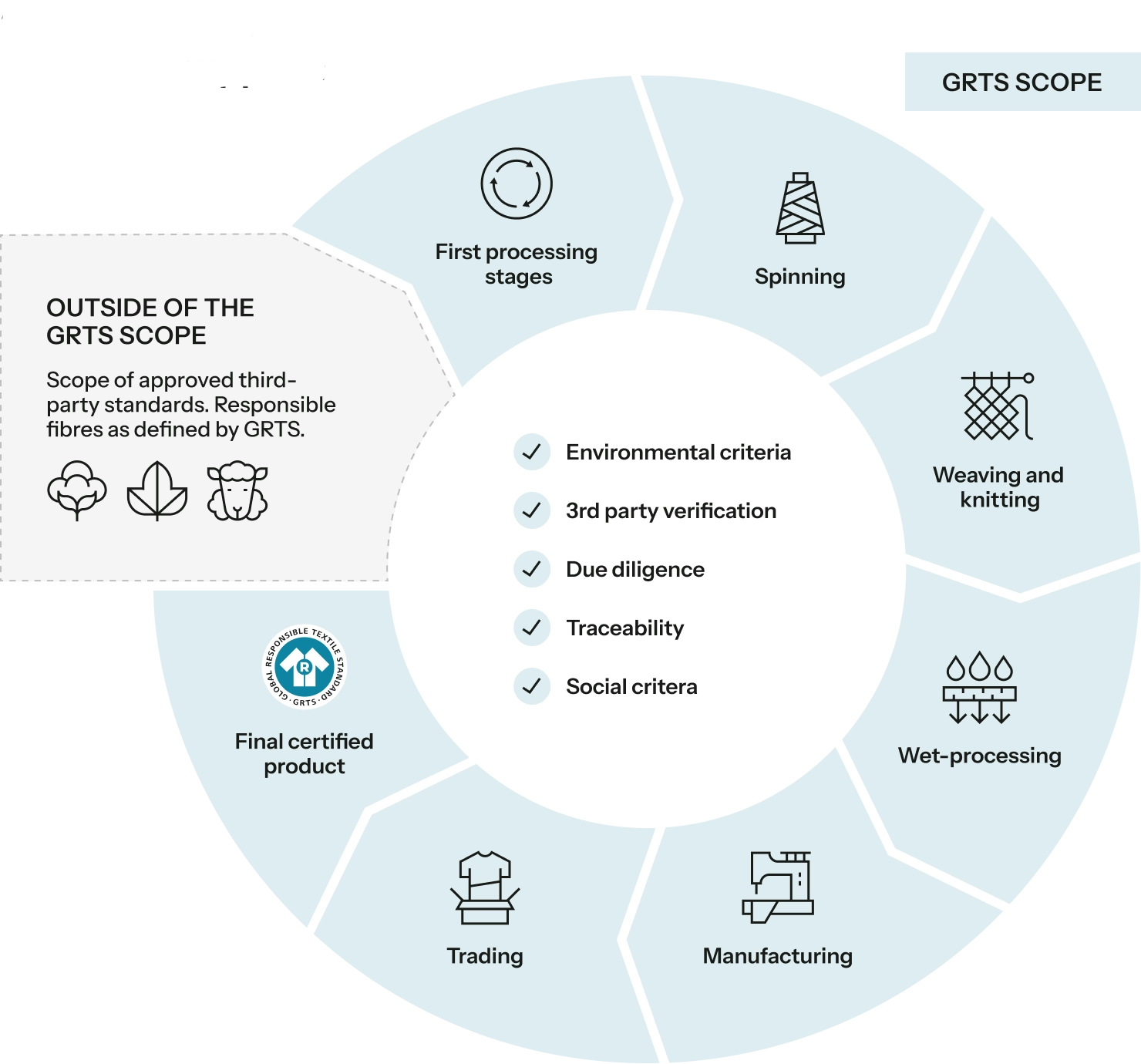 ## Helpful links about GRTS - [Learn more about GRTS](https://gots.vorschau.website/index.php?Itemid=1366) - [Benefits of GRTS](https://gots.vorschau.website/index.php?Itemid=1369) - [Key Features of GRTS](https://gots.vorschau.website/index.php?Itemid=1368) - [Download GRTS resources](https://gots.vorschau.website/index.php?Itemid=1370) - [How to get certified](https://gots.vorschau.website/index.php?Itemid=1381) - [Contact a Global Standards Representative in your region](https://gots.vorschau.website/index.php?Itemid=1363) - [Access full FAQs](https://gots.vorschau.website/index.php?Itemid=1395) ## FAQs around GRTS [Which fibres and fibre production standards are recognised under GRTS? ](#)GRTS applies to textiles made with fibres certified to recognised responsible fibre production standards that are processed under strict environmental, human rights including social criteria along the entire value chain. GRTS products must contain at least 90% recognised responsible fibres. To qualify as “responsible” under GRTS, fibres must meet key criteria including: - third-party certification, - an identity-preserved chain of custody, meaning certified material remains identifiable and traceable throughout the supply chain - non-[GMO](https://gots.vorschau.website/resources/glossary/gmo "Organisms whose genetic material has been altered in a way that does not occur naturally by mating and/or natural recombination. (Source: EUR-Lex, Access to European Union law: https://eur-lex.europa.eu/EN/legal-content/glossary/genetically-modified-organisms-gmo.html)
") requirements, - restrictions on highly hazardous pesticides, - animal welfare safeguards including no [mulesing](https://gots.vorschau.website/resources/glossary/mulesing "Removal of wool-bearing strips of skin from the breech area of sheep intended to avoid problems of flystrike. This includes any type of breech modification, including freeze branding/steining.
"), and - responsible sourcing requirements for forestry-based and bio-based materials. Eligible fibre categories for GRTS include - natural plant and animal fibres - regenerated cellulosic fibres, - recycled natural and synthetic fibres, - biopolymers and - certified organic or [organic in-conversion](https://gots.vorschau.website/resources/glossary/organic-in-conversion "A product from an operation or portion thereof which has completed at least 12 months under organic management and is under the supervision of an Approved Certifier.
") fibres below GOTS thresholds. This approach enables more fibre flexibility while maintaining strict environmental, social and traceability requirements across the entire textile supply chain. [What is the difference between GOTS and GRTS? ](#)GOTS applies the Global Standards certification system to textiles made with certified [organic fibres](https://gots.vorschau.website/resources/glossary/organic-fibres "Lorem Ipsum dolor sit amet
"), while GRTS extends the same system to textiles made with fibres certified to additional recognised responsible standards. Both standards use the same underlying certification, environmental, social, traceability and integrity system developed by Global Standards. This allows companies to apply one consistent system across both organic and non-organic product lines. [Can companies use both GOTS and GRTS? ](#)Yes. Companies can use both GOTS and GRTS across different product lines while operating within one aligned certification system. This enables [brands](https://gots.vorschau.website/resources/glossary/brand "A registered or unregistered trademark or other sign other than the GOTS Signs.
The term, in context, can also refer to an organisation that controls the design, development, and purchase of final products for sale under their own name. In that context, brands may sell to wholesalers, retailers, or directly to consumers. This does not include organisations who sell a branded intermediate product for use in further processing steps.
An entity in the manufacturing chain (sewing industry or so-called CMT (cut, make, trim) industry up to labelling and final packing) of GOTS Goods.
") and suppliers to manage organic and other responsible fibre products under a consistent system for certification, traceability and compliance. Companies seeking certification to both standards can undergo a single combined audit, reducing administrative effort while maintaining the integrity of both certification schemes. [Can a product carry both the GOTS and GRTS label? ](#)No. GOTS and GRTS are separate product certifications with different fibre eligibility requirements, and a product can only be certified to one of the two standards. However, companies can operate both certifications in parallel across different product lines, allowing them to apply one consistent certification, traceability and compliance system across their broader textile portfolio. [How does GRTS support regulatory compliance? ](#)GRTS integrates due diligence principles aligned with internationally recognised frameworks such as the OECD Guidelines and UN Guiding Principles on Business and Human Rights. The standard helps companies strengthen supply chain oversight, support credible [sustainability](https://gots.vorschau.website/resources/glossary/sustainability "In 1987, the United Nations Brundtland Commission defined sustainability as “meeting the needs of the present without compromising the ability of future generations to meet their own needs.”
") claims and prepare for increasing environmental and human rights regulatory requirements.