The worldwide leading voluntary sustainability standard for the post-harvest textile value chain for certified organic fibres, covering environmental criteria, human rights, social criteria and business conduct.
") (Global [Organic](https://gots.vorschau.website/resources/glossary/organic "'Organic' is a regulated term used to distinguish systems of managed production and products derived therefrom that adhere to principles of health, ecology, fairness and care, and which are certified compliant to an organic standard's regulations by an Approved Certification Body.
GOTS defines organic textiles as being made with fibres from organic agriculture systems that are certified to one of the IFOAM Family of Standards, and that are processed in socially and ecologically responsible ways, in alignment with organic principles.
standard glossary text
")) ## A [standard](https://gots.vorschau.website/resources/glossary/standard "standard glossary text
") created to unify organic textile certification globally Before GOTS (Global Organic Textile Standard) existed, multiple national and private organic textile standards covered different parts of the textile supply chain. Different criteria, approaches and requirements created complexity for [brands](https://gots.vorschau.website/resources/glossary/brand "A registered or unregistered trademark or other sign other than the GOTS Signs.
The term, in context, can also refer to an organisation that controls the design, development, and purchase of final products for sale under their own name. In that context, brands may sell to wholesalers, retailers, or directly to consumers. This does not include organisations who sell a branded intermediate product for use in further processing steps.
An entity in the manufacturing chain (sewing industry or so-called CMT (cut, make, trim) industry up to labelling and final packing) of GOTS Goods.
") and Certification Bodies operating internationally. Recognising the global nature of textile production, leading organisations came together in 2002 to create one harmonised international standard for organic textiles. The result was GOTS: a unified global programme for the processing, manufacturing and labelling of textiles made with [organic fibres](https://gots.vorschau.website/resources/glossary/organic-fibres "Lorem Ipsum dolor sit amet
"). Today, GOTS provides a common approach across global supply chains through an internationally recognised standard.  [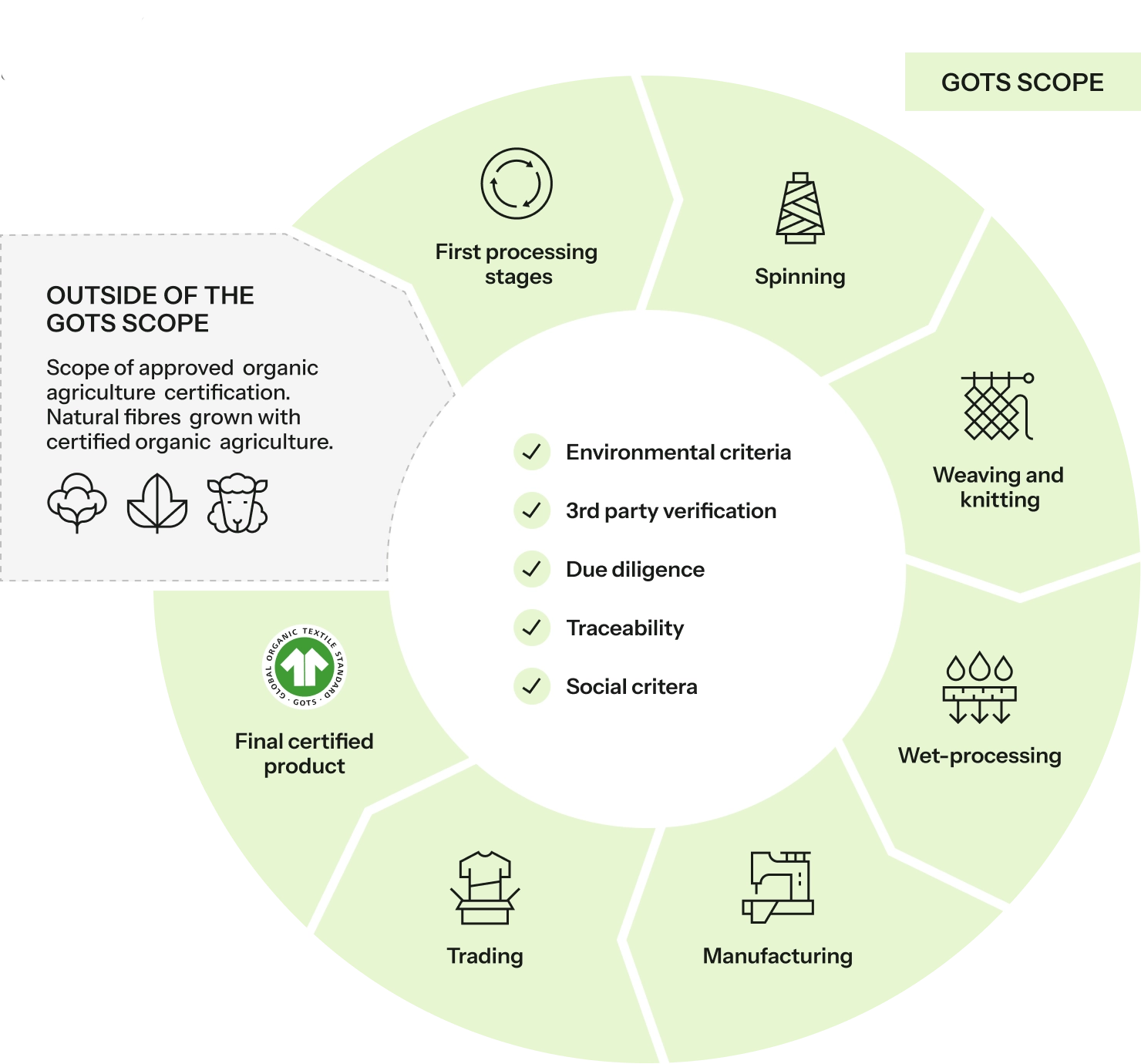](https://gots.vorschau.website/images/Infographics/global-organic-textile-standard-explained-hollistic.webp) ## Which areas does the Global Organic Textile Standard cover? - organic fibre requirements - chemical [input](https://gots.vorschau.website/resources/glossary/input "General term for all Substances and Preparations directly applied as textile auxiliary agents, inks, dyes or pigments.
") restrictions - chemical input approval system - environmental criteria - [human rights](https://gots.vorschau.website/resources/glossary/human-rights "Human rights are rights inherent to all human beings, regardless of race, sex, nationality, ethnicity, language, religion, or any other status. Human rights include the right to life and liberty, freedom from slavery and torture, freedom of opinion and expression, the right to work and education, and many more. Everyone is entitled to these rights, without discrimination. (Source: Office of the High Commissioner for Human Rights, United Nations)
") including social responsibility criteria - processing and manufacturing requirements - product safety requirements - [traceability](https://gots.vorschau.website/resources/glossary/traceability "The ability to trace the origin of an object back to its source.
In a GOTS context, the ability to trace a GOTS Good as it moves through its supply chain.
An individual establishment where chemical Inputs are formulated (see Formulator) and produced. It is included in a Letter of Approval and audited by a Scope 4 Approved Certifier.
") inspections and additional risk-based measures. [Environmental and chemical requirements ](#)GOTS sets strict criteria for environmental management including wastewater, air and GHG emission, packaging and textile waste. To proactively safeguard the responsible processing practices throughout textile production, GOTS operates a chemical approval scheme where chemicals are assessed against strict GOTS chemical input criteria and listed under GOTS [Positive List](https://gots.vorschau.website/resources/glossary/positive-list "GOTS Positive List contains GOTS-compliant chemical products which are evaluated and approved by GOTS approved chemical auditors. The List provides trade names of the chemicals and immediate access to all chemical Inputs which are allowed to use GOTS products.
"). [Human rights and social responsibility criteria ](#)GOTS includes human rights including social requirements aligned with internationally recognised norms and frameworks, covering issues such as safe working conditions, the prohibition of child labour and forced labour, non-discrimination, fair treatment and responsible employment practices. [Traceability and transparent claims ](#)[Transaction Certificates](https://gots.vorschau.website/resources/glossary/transaction-certificate "A document issued by a GOTS-approved Certification Body for GOTS-certified products, verifying their compliance with the Standard. It provides traceability by listing product details, shipment information and confirming integrity through volume reconciliation process.
") and labelling requirements support traceability and help brands and [retailers](https://gots.vorschau.website/resources/glossary/retailer "A business entity or an online marketplace selling directly and exclusively to an end consumer (DTC operator).
") communicate claims with greater credibility and consistency. A GOTS Transaction Certificate (TC) is required each time ownership of certified goods changes hands. [Trusted by leading brands and manufacturers worldwide ](#)GOTS is used globally by brands, manufacturers, [processors](https://gots.vorschau.website/resources/glossary/processor "An entity in the processing chain (post-harvest handling up to finishing) of GOTS Goods.
"), [traders](https://gots.vorschau.website/resources/glossary/trader "Entity trading with (=buying and selling) GOTS Goods in the supply chain between the producer of the fibre and the retail merchant of the final product regardless of whether the goods are physically received or not (e.g. an import, export or wholesale trading entity).
Agents who do not become proprietors of the goods and retailers only selling to the end consumer are not considered Traders.
In 1987, the United Nations Brundtland Commission defined sustainability as “meeting the needs of the present without compromising the ability of future generations to meet their own needs.”
") statements. [Meeting market expectations ](#)GOTS helps companies respond to growing demand for certified organic textile products from brands, retailers and consumers. [One recognised standard across global operations ](#)GOTS provides a globally established system recognised across international textile supply chains, helping reduce fragmentation and complexity compared to multiple regional approaches. [Reducing claim-related risk ](#)Clear criteria, approved inputs and controlled labelling help support more reliable product communication.  ## More than a label GOTS is a globally harmonised programme for credible organic textile processing and manufacturing. ## Helpful links - [How to get certified](https://gots.vorschau.website/index.php?Itemid=1381) - [Access all FAQs](https://gots.vorschau.website/index.php?Itemid=1395) - [Contact a Global Standards Representative in your region](https://gots.vorschau.website/index.php?Itemid=1363) - [How do I correctly label a GOTS-certified product?](https://gots.vorschau.website/index.php?Itemid=1396) - [Access the Standard document](https://gots.vorschau.website/index.php?Itemid=1388) - [What are the key features of GOTS](https://gots.vorschau.website/index.php?Itemid=1377) - [What are the benefits of GOTS](https://gots.vorschau.website/index.php?Itemid=1376) ## FAQs [How do I get GOTS-certified? ](#)Companies can become GOTS-certified by applying through an approved independent [Certification Body](https://gots.vorschau.website/resources/glossary/certification-body "A Certification Body, having been duly accredited by an Accreditation Body and by way of signing a contract with Global Standard gGmbH has been permitted to implement the Global Organic Textile Standard over a designated geographical area and for specific scopes of the Standard.
"). Certification includes a review of processes, inputs, documentation and on-site operations to verify compliance with the GOTS criteria across the processing, manufacturing or trading activities. [Which Certification Bodies can certify to GOTS? ](#)GOTS certification can only be carried out by approved independent Certification Bodies. These Certification Bodies conduct [audits](https://gots.vorschau.website/resources/glossary/audit "A systematic, independent and documented process for obtaining evidence and evaluating it objectively to determine the extent to which the Standard's requirements (including environmental and social criteria) are fulfilled by a Certified Entity or applicant for the status of Certified Entity. Audits are conducted by Approved Certification Bodies (see 'Approved Certification Body').
") and certification activities according to the GOTS system requirements. A list of approved Certification Bodies is available [here.](https://gots.vorschau.website/index.php?Itemid=1383) [What are the steps to achieve GOTS-certification? ](#)The certification process typically includes: - Selecting an [approved Certification Body](https://gots.vorschau.website/resources/glossary/approved-certification-body "An Approved Certification Body or Approved Certifier is a certification body that has been duly accredited by an Accreditation Body. By signing a con tract with Global Standard gGmbH, they are permitted to implement the Global Organic Textile Standard within a designated geographical area and for specific scopes of the Standard. An updated list of Approved Certifiers and their scopes is available on the GOTS Website.
") - Submitting an application and company information - Reviewing materials, chemical inputs and processes - Completing an on-site audit - Addressing any non-conformities if required - Receiving certification upon successful compliance verification [I have additional questions. Whom can I contact? ](#)Global Standards Representatives can provide initial guidance and orientation on the GOTS and GRTS certification process. Companies seeking more in-depth implementation support may also work with approved external consultants specialising in GOTS and GRTS certification and supply chain compliance. Contact information and regional support details are available [here.](https://gots.vorschau.website/index.php?Itemid=1359)