'Organic' is a regulated term used to distinguish systems of managed production and products derived therefrom that adhere to principles of health, ecology, fairness and care, and which are certified compliant to an organic standard's regulations by an Approved Certification Body.
GOTS defines organic textiles as being made with fibres from organic agriculture systems that are certified to one of the IFOAM Family of Standards, and that are processed in socially and ecologically responsible ways, in alignment with organic principles.
standard glossary text
") ([GOTS](https://gots.vorschau.website/resources/glossary/gots "The worldwide leading voluntary sustainability standard for the post-harvest textile value chain for certified organic fibres, covering environmental criteria, human rights, social criteria and business conduct.
")) ## The global benchmark for the processing of organic textiles The Global Organic Textile [Standard](https://gots.vorschau.website/resources/glossary/standard "standard glossary text
") (GOTS) is a globally recognised certification for textiles made with [organic fibres](https://gots.vorschau.website/resources/glossary/organic-fibres "Lorem Ipsum dolor sit amet
"). It combines strict environmental, [human rights](https://gots.vorschau.website/resources/glossary/human-rights "Human rights are rights inherent to all human beings, regardless of race, sex, nationality, ethnicity, language, religion, or any other status. Human rights include the right to life and liberty, freedom from slavery and torture, freedom of opinion and expression, the right to work and education, and many more. Everyone is entitled to these rights, without discrimination. (Source: Office of the High Commissioner for Human Rights, United Nations)
") including social requirements with independent certification across the entire textile processing supply chain. GOTS starts where organic farming activities ends. GOTS certification covers every step of production, from fibre processing and spinning to wet processing, manufacturing and trading. To label a product as GOTS-certified, all companies involved in its production must be certified by approved independent Certification Bodies.  ## Which requirements does GOTS define? - the use of certified organic fibres - chemical [inputs](https://gots.vorschau.website/resources/glossary/input "General term for all Substances and Preparations directly applied as textile auxiliary agents, inks, dyes or pigments.
") and environmental management - wastewater treatment and responsible processing - Human rights and environmental criteria - due diligence criteria based on internationally recognised norms - [traceability](https://gots.vorschau.website/resources/glossary/traceability "The ability to trace the origin of an object back to its source.
In a GOTS context, the ability to trace a GOTS Good as it moves through its supply chain.
An individual establishment where chemical Inputs are formulated (see Formulator) and produced. It is included in a Letter of Approval and audited by a Scope 4 Approved Certifier.
") [audits](https://gots.vorschau.website/resources/glossary/audit "A systematic, independent and documented process for obtaining evidence and evaluating it objectively to determine the extent to which the Standard's requirements (including environmental and social criteria) are fulfilled by a Certified Entity or applicant for the status of Certified Entity. Audits are conducted by Approved Certification Bodies (see 'Approved Certification Body').
") of certified facilities and transaction-based verification systems to help ensure product integrity throughout the supply chain. Today, GOTS is used by [brands](https://gots.vorschau.website/resources/glossary/brand "A registered or unregistered trademark or other sign other than the GOTS Signs.
The term, in context, can also refer to an organisation that controls the design, development, and purchase of final products for sale under their own name. In that context, brands may sell to wholesalers, retailers, or directly to consumers. This does not include organisations who sell a branded intermediate product for use in further processing steps.
An entity in the manufacturing chain (sewing industry or so-called CMT (cut, make, trim) industry up to labelling and final packing) of GOTS Goods.
"), [processors](https://gots.vorschau.website/resources/glossary/processor "An entity in the processing chain (post-harvest handling up to finishing) of GOTS Goods.
"), [traders](https://gots.vorschau.website/resources/glossary/trader "Entity trading with (=buying and selling) GOTS Goods in the supply chain between the producer of the fibre and the retail merchant of the final product regardless of whether the goods are physically received or not (e.g. an import, export or wholesale trading entity).
Agents who do not become proprietors of the goods and retailers only selling to the end consumer are not considered Traders.
A business entity or an online marketplace selling directly and exclusively to an end consumer (DTC operator).
") worldwide as a tool to support credible organic textile production and communicate verified claims with greater transparency and consistency. It thus enables textile companies to build credible, compliant, and globally recognised supply chains for organic products. 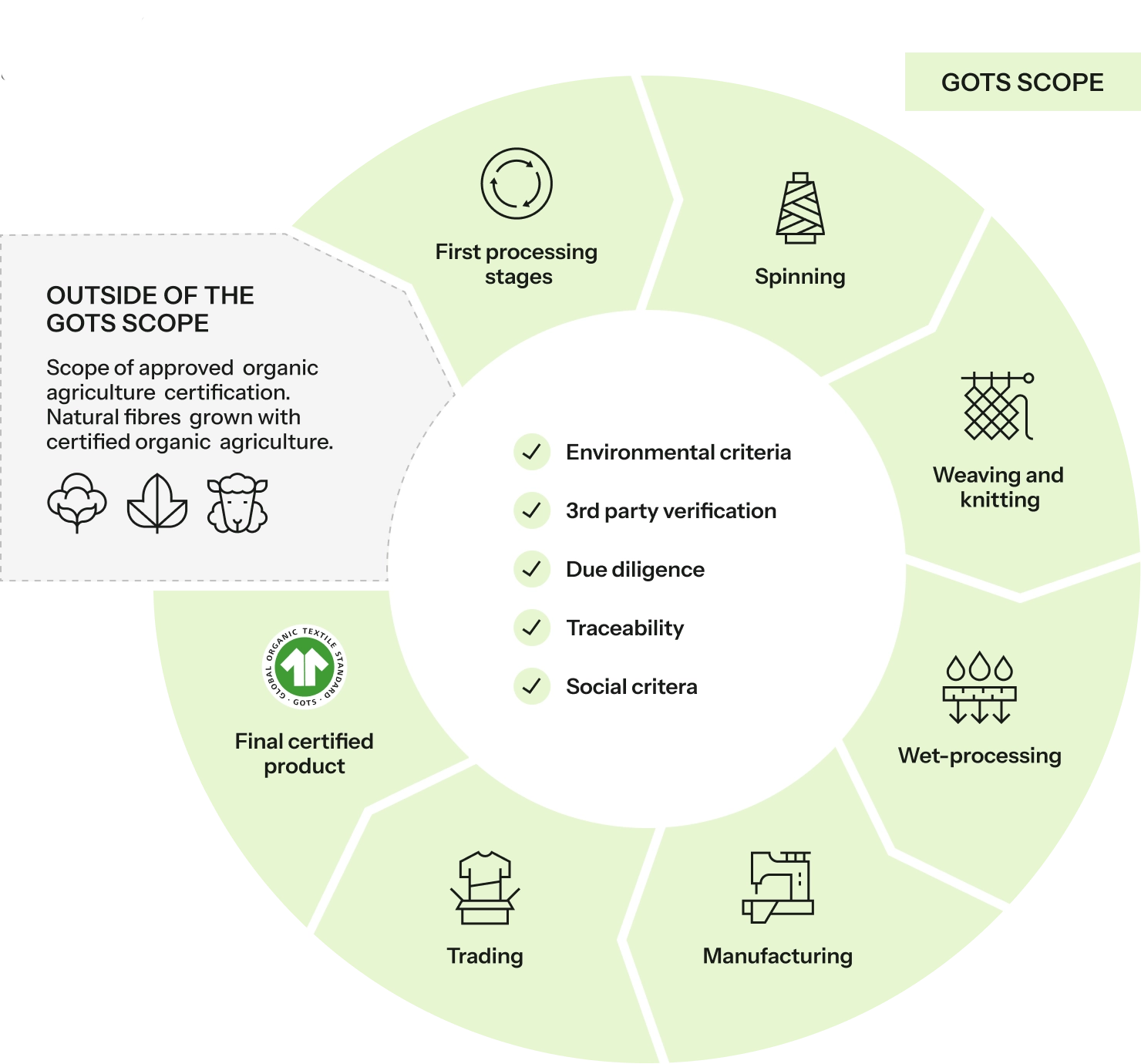 ## Helpful links about GOTS - [Learn more about GOTS](https://gots.vorschau.website/index.php?Itemid=1379) - [Benefits of GOTS](https://gots.vorschau.website/index.php?Itemid=1376) - [Key Features of GOTS](https://gots.vorschau.website/index.php?Itemid=1377) - [Download GOTS resources](https://gots.vorschau.website/index.php?Itemid=1375) - [How to get certified](https://gots.vorschau.website/index.php?Itemid=1381) - [Contact a Global Standards Representative in your region](https://gots.vorschau.website/index.php?Itemid=1363) - [Access full FAQs](https://gots.vorschau.website/index.php?Itemid=1395) ## FAQs around GOTS [Which fibres are allowed under GOTS? ](#)GOTS applies to a wide range of certified organic natural fibres. These include vegetable fibres such as cotton, hemp, linen/flax and jute, and animal fibres such as sheep wool, cashmere, mohair, alpaca and silk. In addition, the standard permits the use of specific additional fibres that can be blended with organic fibres. The standard covers the entire textile processing and manufacturing supply chain, from fibre processing to finished product. [Do all suppliers in the supply chain need to be GOTS-certified? ](#)Yes. To sell a product as GOTS-certified, each company involved in the processing of the product must be certified by an approved independent [Certification Body](https://gots.vorschau.website/resources/glossary/certification-body "A Certification Body, having been duly accredited by an Accreditation Body and by way of signing a contract with Global Standard gGmbH has been permitted to implement the Global Organic Textile Standard over a designated geographical area and for specific scopes of the Standard.
"). This creates one consistent and traceable system from fibre processing to finished product. [How does GOTS verify product integrity and traceability? ](#)A combination of tried-and-tested integrity measures and cutting-edge technologies ensures the transparency, credibility and trust of GOTS certified products. GOTS combines independent certification, annual on-site audits, transaction verification, publicly disclosed enforcement measures and strict chain-of-custody requirements to ensure integrity and traceability throughout the entire supply chain. Unlike systems based on mass balance approaches, GOTS uses physical segregation and [volume reconciliation](https://gots.vorschau.website/resources/glossary/volume-reconciliation "Calculation process by which it is ascertained that output volumes of a product’s certified materials are compatible with their corresponding input volumes. Input volume and output volume of the certified material used for a product are compatible if their ratio falls within a given percentage range, which reflects estimated production losses specific to the production process of the particular product, and if the input volume can be demonstrated to have been available on stock.
") mechanisms designed to maintain product integrity across all processing and trading stages, further strengthened through collaboration with the European Space Agency (ESA) on satellite-based cotton monitoring technology. More information is available [here.](https://gots.vorschau.website/index.php?Itemid=1356) [Is GOTS recognised internationally? ](#)Yes. GOTS is globally recognised and widely used across international textile supply chains and major markets. Its credibility is reinforced by recognition and reference from governments, public institutions and international organisations, including the European Union, the OECD, the United Nations and the United States Department of Agriculture (USDA), GOTS is also referenced in public procurement frameworks and [sustainability](https://gots.vorschau.website/resources/glossary/sustainability "In 1987, the United Nations Brundtland Commission defined sustainability as “meeting the needs of the present without compromising the ability of future generations to meet their own needs.”
") guidance used by brands, retailers and manufacturers worldwide.